Blog · Travel & San Diego life
Travel & lifestyleThis weekend, Old Town remembers.
The short version: Día de los Muertos takes over Old Town San Diego State Historic Park from Saturday, October 31 to Monday, November 2, 2026, 10 a.m. to 5 p.m. each day. There are more than 40 altars to walk, a community altar you can add a photo to, pan de muerto to hunt down, a Catrina Contest on Sunday at 2 p.m., and a candlelit procession to El Campo Santo Cemetery on Monday after sunset. The park celebration is free.
Día de los Muertos in Old Town San Diego. Courtesy of San Diego Tourism Authority.
Today is Halloween, and San Diego will do Halloween properly tonight. But the weekend's bigger story is already set up a few streets over, and it has been building since October 1: Día de los Muertos in Old Town, running Saturday through Monday at the State Historic Park.
Quick distinction, because people mix these two up every year. Halloween is about being scared for fun. Día de los Muertos — November 1 and 2 — is about remembering people who have died, and doing it warmly. You build them an altar. You cook what they liked. You say their names out loud. Grief shows up, sure, but so does music, and colour, and a lot of food. It is a reunion more than a memorial.
You do not need a flight to Mexico City for any of this. San Diego does its own version at home, in the oldest part of town, and this year is the celebration's 16th year here. Here is how I would work the weekend.
Start with the altars. All forty-something of them.
An ofrenda is the altar at the centre of all this: photographs of the person being remembered, candles, marigolds — cempasúchil, the orange ones you will smell before you see them — plus the food and drink that person loved, set out to welcome them back for these two days. Old Town has more than 40 of them this weekend, built by local businesses, museums and families, spread through the park and along the streets. The self-guided walk is the main event. Take it slow.
Inside the park's historic museums, the altars honour people who actually lived in Old Town generations ago — you'll find them at La Casa de Estudillo, the Machado houses and Seeley Stable, among others. State Parks also runs free 45-minute guided altar tours from the Robinson Rose Visitor Center if you want the stories behind the photos. Those need registration, so check at the visitor center first.
And then there is the one you can join. The Community Altar in the Plaza de Armas is a traditional seven-tiered altar, open 10 to 5 all three days, and anyone can attach a photo of a loved one to it with a safety pin. One warning, straight from State Parks: anything you place on it will not be returned. So bring a copy, not the only print you own. Next to it, there is a wall of hanging wooden butterflies — you decorate one, write a name on it, and hang it up. Suggested donation is $5. Small thing. It stays with you.
The food to hunt: pan de muerto
My beat on any altar is the bread. Pan de muerto, literally "bread of the dead," is a round sweet loaf scented with orange zest and orange blossom water and dusted with sugar. Look at the top: a little ball of dough in the centre, with strips crossed around it. That is a skull and bones, baked in. In Mexican tradition, the orange blossom scent is part of the point — it is believed to help guide the visiting souls home, the same job the marigolds do with their colour and smell.
Families put a loaf on the ofrenda as an offering, and then — this is the part I respect — everybody eats it too, usually with hot chocolate nearby. It only shows up in bakeries for a few weeks a year, so this weekend is peak season. Your best bets in Old Town are the Weekend Mercado, which runs Saturday and Sunday along San Diego Avenue and Harney Street, and the food stalls around Fiesta de Reyes. If you are coming from another neighbourhood, stop at your local panadería on the way and ask — but ask early in the day. This bread does not sit around until evening on Día de los Muertos weekend.
One more food note, because it confuses people: the sugar skulls are not snacks. At the Plaza de Armas you can decorate your own in a workshop with sugar skull artist Carolina Celaya — $10 for materials, all ages — and State Parks is very clear that those skulls are decorative only, not for eating. Paint one for the altar. Eat the bread. Correct order.
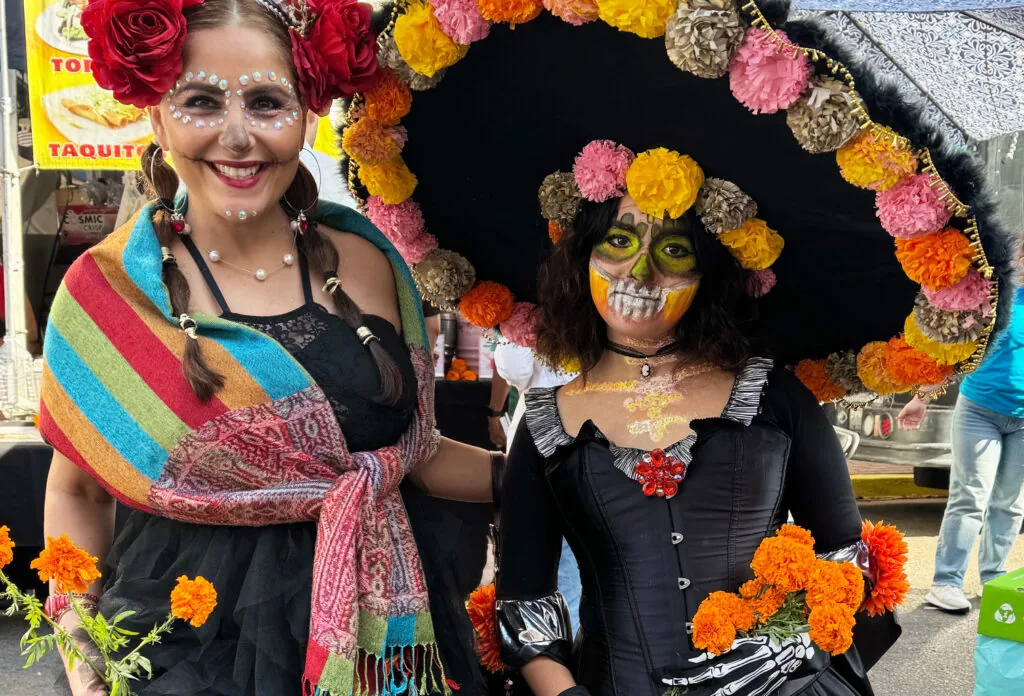
A Catrina Contest winner from a past year's celebration at Fiesta de Reyes. This year's contest is Sunday at 2 p.m. Courtesy of Fiesta de Reyes.
How the three days break down
Saturday is the fullest plate. Park hours are 10 to 5, the mercado is up, and the hands-on art in the Plaza de Armas is free — park interpreters will show you how to make the paper flowers and cut the papel picado, those bright tissue-paper banners, that you see on altars. Over at Fiesta de Reyes, in the north corner of the park, the fiesta runs later than the park day: 11 a.m. to 9 p.m. on Saturday, with face painters, art demos, live entertainment and its own altars, plus mariachi and folklorico dancers. The courtyard there goes big — larger-than-life catrinas, decorated skulls everywhere, thousands of marigolds.
Sunday is my pick. The mercado runs for its second day, Fiesta de Reyes goes 11 to 6, and at 2 p.m. in the Plaza de Armas the Catrina Contest starts — kids first, then adults — with people competing in full Catrina dress: the elegant skeleton look, wide hats, painted faces, the works. My plan is to be there for that, pan de muerto in hand.
Monday is quieter, and then it isn't. The park day runs 10 to 5 as usual. After sunset, the candlelit procession walks down San Diego Avenue to El Campo Santo Cemetery, one of the oldest cemeteries in the city. The Tourism Authority's listing has it starting at Immaculate Conception Church at 5 p.m., with blessings and traditional dances by Danza Azteca Atlachinolli; the State Parks page lists a 6 p.m. start from Twiggs Street. Two official sources, two times — check the official schedule on the day, and just be in place early. Standing on that avenue with the candles coming past is the moment this whole weekend is pointed at.
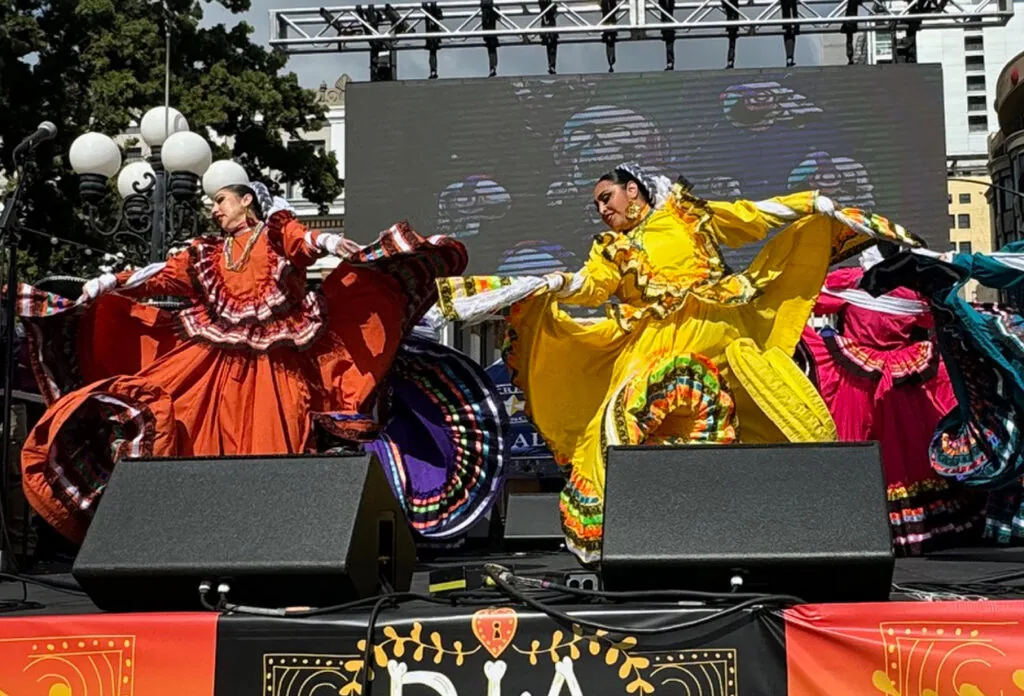
Dancers at Fiesta de Reyes, which keeps the music and altars going through Monday, November 2. Courtesy of Fiesta de Reyes.
Getting there without the parking headache
Real talk: Old Town gets packed for this, and State Parks charges a parking fee in all of its lots during the event. Lot F is closed entirely. There is overflow parking at the CalTrans lot at 4300 Taylor Street.
The easier play is the one State Parks itself suggests. The Old Town Transit Center sits right next to the park — trolley, Coaster, buses. Ride in, walk two minutes, skip the circling. Future you, holding a warm loaf of pan de muerto on the ride home, says thanks.
Two festivals, one month, same idea
San Diego is getting a double dose of this right now. Sunday, November 8, is Diwali — different tradition, different part of the world, same basic move: light small flames in the dark, feed everybody, remember what matters. I wrote up my Diwali table earlier this week, rabri cannoli and all. And if all this talk of seasonal baking has you in a kitchen mood, the persimmon bread is the other thing I keep making while fall fruit is still around.
But this weekend belongs to Old Town. Bring a copy of a photo. Write a name on a butterfly. Eat the bread while it is still this weekend.
Altars, the Catrina Contest, and my pan de muerto report from Old Town — that is where my camera is pointed this weekend, over at @chefshanu.
Follow @chefshanu ↗Quick answers.
When is Día de los Muertos in Old Town San Diego in 2026?
The State Park celebration runs Saturday, October 31 to Monday, November 2, 2026, from 10 a.m. to 5 p.m. each day at Old Town San Diego State Historic Park. Fiesta de Reyes, in the north corner of the park, keeps its own fiesta hours that weekend: Saturday until 9 p.m. and Sunday until 6 p.m.
Is Old Town's Día de los Muertos free?
The park celebration is free, including the hands-on art in the Plaza de Armas on Saturday and Sunday. A few things cost a little: decorating a sugar skull is $10 for materials, the butterfly remembrance suggests a $5 donation, and State Park parking lots charge a fee during the event.
What is pan de muerto?
Pan de muerto — "bread of the dead" — is a round, sugar-dusted sweet bread scented with orange zest and orange blossom water. The ball and crossed strips of dough on top stand for a skull and bones. Families place it on ofrendas during Día de los Muertos, on November 1 and 2.
What is an ofrenda?
An ofrenda is the altar built for Día de los Muertos: photographs of loved ones who have died, marigolds (cempasúchil), candles, and the food and drink they loved, set out to welcome them back on November 1 and 2. Old Town has more than 40 altars on display this weekend.
When is the candlelit procession in Old Town?
Monday, November 2, 2026, after sunset, ending at El Campo Santo Cemetery on San Diego Avenue. Official listings show two start times — a 5 p.m. kickoff on the San Diego Tourism Authority listing and 6 p.m. on the California State Parks page — so check the official schedule before you go and arrive early either way.